

University of Saskatchewan
Honours, Mathematical Physics & Computer Science
High Honours
Awards, activities and coursework at the University of Saskatchewan
Hi, I’m Hakeem, and I love Physics and AI. I want to be useful to other humans, understand more about the universe, and help answer some of the big questions.
Algoverse AI Research Program
Advanced Physics Research Lab, University of Saskatchewan
Department of Mathematics & Statistics, University of Saskatchewan
quanTA, University of Saskatchewan
First author. Accepted to AACL-IJCNLP 2026 (Hengqin, China, November 2026) and to multiple ICML workshops.
This paper studies safety failures in memory-augmented conversational LLMs, especially cross-domain leakage and memory-induced sycophancy. It proposes inference-time structured memory representations that partition memories by domain instead of injecting all stored user memories as a flat list. Across seven models on PersistBench, the strongest dynamic partitioning method reduces cross-domain leakage by 8.8 percent on average relative to the baseline while preserving useful personalization.
Read the paper : Mitigating Over-Personalization in LLMs via Structured Memory Download PDF of Mitigating Over-Personalization in LLMs via Structured Memory arXiv:2608.08300 (opens in a new tab)
Author. Undergraduate Honours Thesis.
Research on symmetry methods for solving non-linear partial differential equations — using the structure of a system's symmetries to construct exact and reduced solutions where direct integration fails.
Read the thesis : Honours Thesis Download PDF of Honours Thesis
Co-author, with Cole Dutchyn (opens in a new tab) and Jason Main (opens in a new tab). 2025 Mathematical Contest in Modeling (MCM), Problem B, University of Saskatchewan.
A model of sustainable cruise tourism in Juneau, Alaska, written over four days for the 2025 Mathematical Contest in Modeling. Taking its cue from RollerCoaster Tycoon, it follows every tourist's happiness through the day as they choose among the glaciers, whale watching, the tram and the city. Crowding and a tourism tax raise or lower that happiness, and happier visitors bring more ships in the days that follow. Raising the tax from 5 percent to 22.5 percent keeps the city's carbon footprint stable, while 15 to 20 percent gives the lowest carbon footprint per dollar of tourism revenue.
Read the paper : Sustainable Tourism in Juneau, Alaska: A Stochastic Multi-Agent Model Download PDF of Sustainable Tourism in Juneau, Alaska: A Stochastic Multi-Agent Model
Got tired of fighting clunky forms to log my workouts, so I built an app that logs everything for me when I just talk to it.
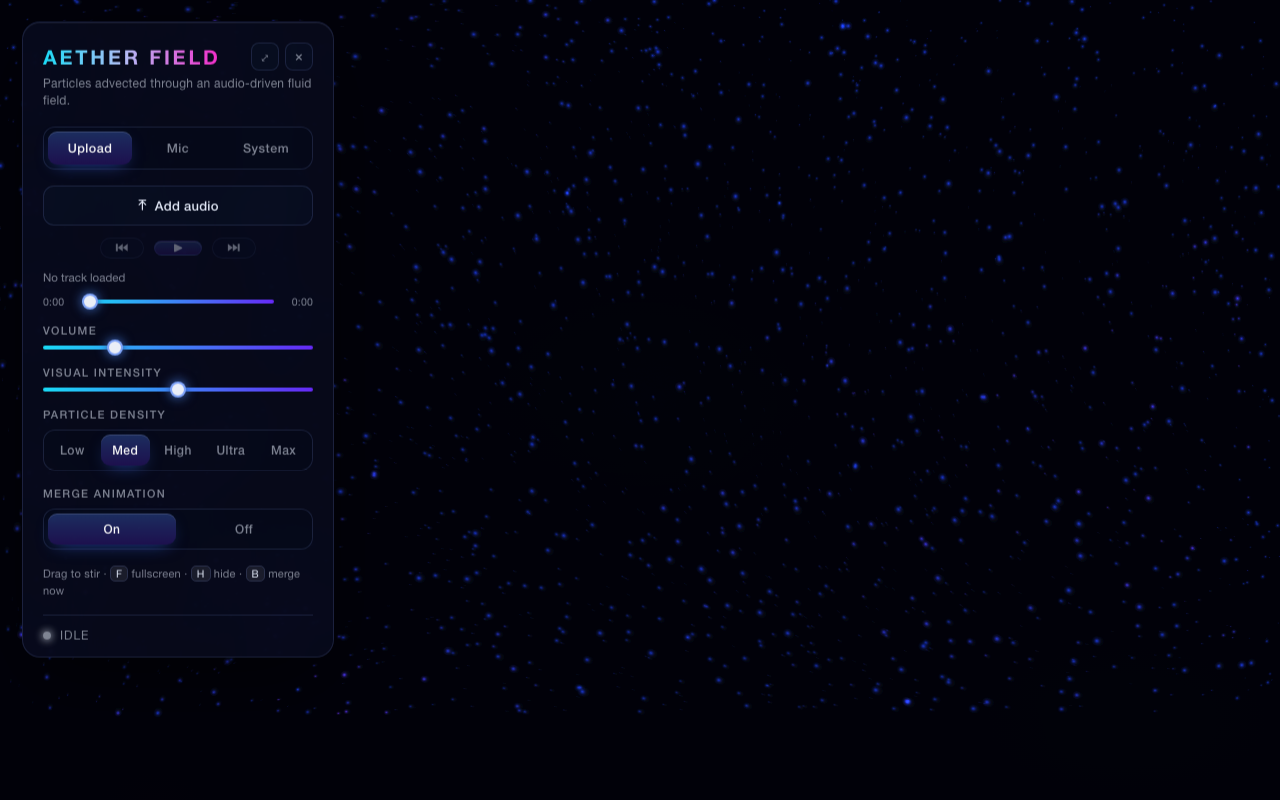
I really liked Windows XP media player as a kid, so wanted to make a new one.
Visit hakeem-hannoon.github.io/aether-field (opens in a new tab)
Built a RAG-powered nutrition scout so retrieval can chase new Starbucks drinks before static food tables wake up.
Honours, Mathematical Physics & Computer Science
High Honours
Awards, activities and coursework at the University of Saskatchewan
Master of Data Science & Artificial Intelligence
Write to me about research, collaboration, or any question you have.